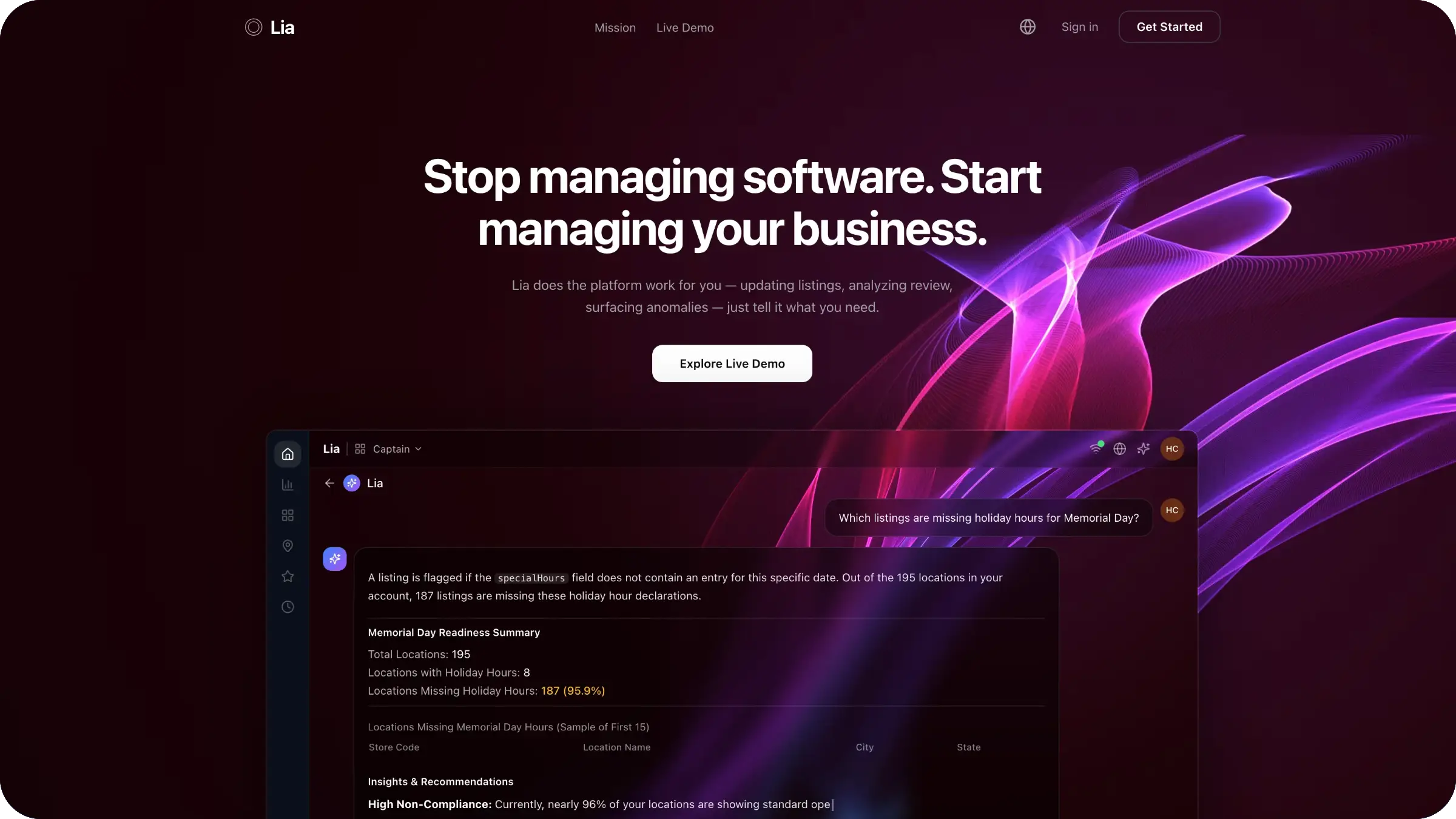
A New Way to Work. Go from Intent to Action, instantly.
For decades, enterprise software has asked you to learn its language before you could solve your business problems. Navigate the right menu. Find the correct dashboard. Master the module structure. Only then could you actually get work done—and even the simplest tasks required multiple steps across different screens.
Lia changes this entirely.
Instead of requiring you to learn where things are, Lia lets you simply say what you need. "Set holiday hours for all my listings." "Add a secondary category to this location." "Show me any listings missing phone numbers." Lia understands your intent and takes action immediately—no navigation required, no learning curve to overcome.
This represents a fundamental shift in how enterprise software works. By embedding execution directly into the moment of intent, Lia eliminates the traditional gap between recognizing what needs to be done and actually doing it. The result is software that adapts to how you naturally work, rather than demanding you adapt to it.
With Lia, your platform becomes less about knowing how to use the system and more about getting things done—the way it should be.
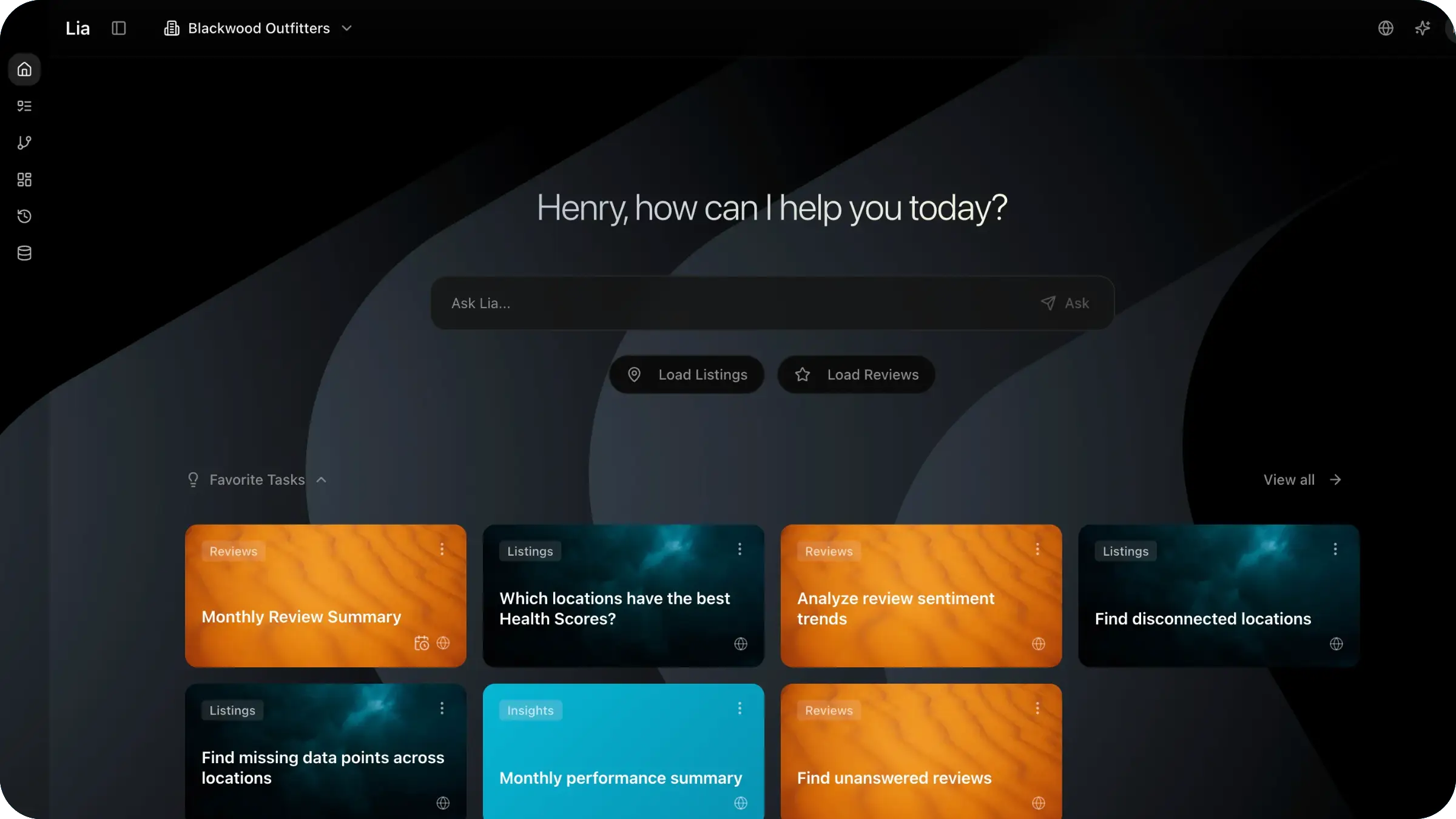
The new Lia home experience is designed to be a clear starting point for action, not a dashboard users need to learn before they can be productive. From the moment users arrive, Lia presents a single, focused prompt that invites them to state their intent directly, shifting the experience from navigation-driven to task-driven.
Users can ask Lia a question or issue a command using natural language, such as loading listings, reviewing reputation data, or initiating a workflow. Common actions are also surfaced as quick-access buttons beneath the prompt, allowing users to immediately load listings or reviews without typing. This balances flexibility for advanced users with speed for common tasks.
The left-hand navigation provides persistent access to core areas like Tasks, Workflows, Dashboard, Locations, Reviews, and History, while keeping the primary focus on the central interaction with Lia. Favorite Tasks are surfaced for fast repeat access, reinforcing continuity and reducing repetitive setup. Global controls and settings remain available but unobtrusive, ensuring they never compete with the main flow.
Together, these elements create a unified experience where users no longer need to decide where to go first. Instead, they simply tell Lia what they want to accomplish, and the platform guides execution from there. This establishes Lia as the primary interface for moving from intent to action across listings, reviews, and workflows.
See it in action at localclarity.ai.
Lia represents more than a new interface — it introduces a fundamentally different way of building and using enterprise software. For users, this means interacting with the platform through intent and action rather than navigation and training. For developers, it means enhancements are no longer bound to rigid UI flows or long release cycles.
Because Lia operates as an orchestration layer between user intent and platform capabilities, new functionality can be introduced quickly and naturally. Enhancements that once required weeks of design, implementation, and user retraining can now be rolled out in days, often without changing how users interact with the system at all. Users simply ask Lia to do more, and it does.
This shift accelerates innovation on both sides of the product. Users gain access to new capabilities immediately, without needing to relearn workflows, while developers can focus on expanding what the platform can do rather than where features live. As Lia continues to evolve, it will increasingly become the primary way users engage with LocalClarity — not as a feature, but as the foundation for how the platform grows and adapts over time.


